
“When I painted it in 1948 Christina’s World hung all summer in my house in Maine and nobody reacted to it. I thought ‘boy is this one ever a flat tyre’
Quoted by Wanda M. Corn in her 1973 book ‘The Art of Andrew Wyeth’
There are images that hold more importance for me as an artist than many more famous works. My influences are obvious through my own work – Bridget Riley who became an idol for me in the late 1960’s when I first discovered her work as an art student in Stafford; Claud Monet whose ‘Haystacks’ series opened my eye to the true wonder of sharp observation of colour; Trechikoff whose fame warned me of the dangers of kitsch and popularity; Edward Hopper who opened a door on the development of art with a history that embraced the American rural tradition as well as strong graphic skills rather than the narrow cosmopolitan European post cubist history ; then the direct patient skills in looking and painting that are epitomized in the work of Andrew Wyeth.
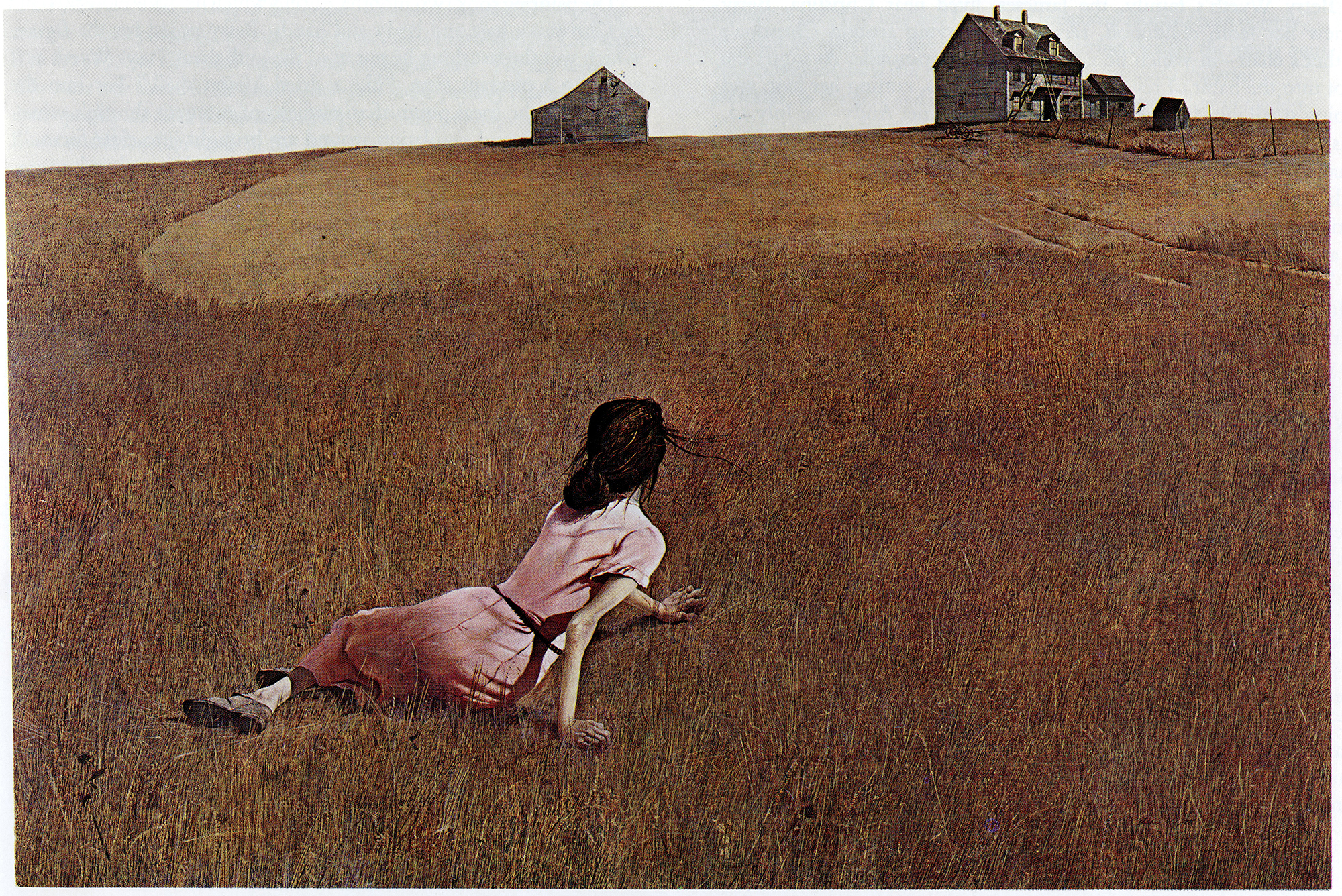
Christina in the painting was not an invention; she was someone known to Wyeth who had been disabled as a youngster by polio. Polio was nearly obliterated in the UK as a punishing crippling disease of childhood by the administration of inoculation through sugar lump. As a child in the 1950’s I lined up in the clinic across the road from my rural junior school to be given a sugar lump to consume containing a dose of polio vaccine, as part of a British mass vaccination of children. Getting us to take it was not a problem coming as it did at the end of sugar rationing – yummy.
It must be difficult for anyone born after the 60’s to imagine how important single images could be in forming imagination and memory for someone older. Newer post boomer generations suffered the impact first of television. My first experience of television was sitting on my father’s knee in the Sergeants Mess watching the 1953 coronation of Queen Elizabeth 2 in black and white. I was probably 9 before we had our own black and white TV. Today’s proliferation of screens from wristwatches through tablets, laptops, TV screens, colour magazines and advertising create visual cacophony that must numb the visual memory and desensitize the vision of those living under visual bombardment in the hive cities.
For me certain images became almost fixed points around which my visual world rotated. Many were of moments in reality, such as when I witnessed St. Elmo’s fire on an aeroplane wing in my first flight in 1963, or the landscapes I lived in like the Lancashire moorland, much as for Wyeth his visual world was the landscape and farmland where he lived in Maine. His image of Christina isolated in a field of grass carries undertones that reach beyond her disability and isolation into ancient landscape memories inherited from our early generations. The significant recent domination of humanity by the noise of the hive, the business of cities, only really developed in the late twentieth century although its birth roots were the late 19th century industrialization sucking people off the land in search of a better life.
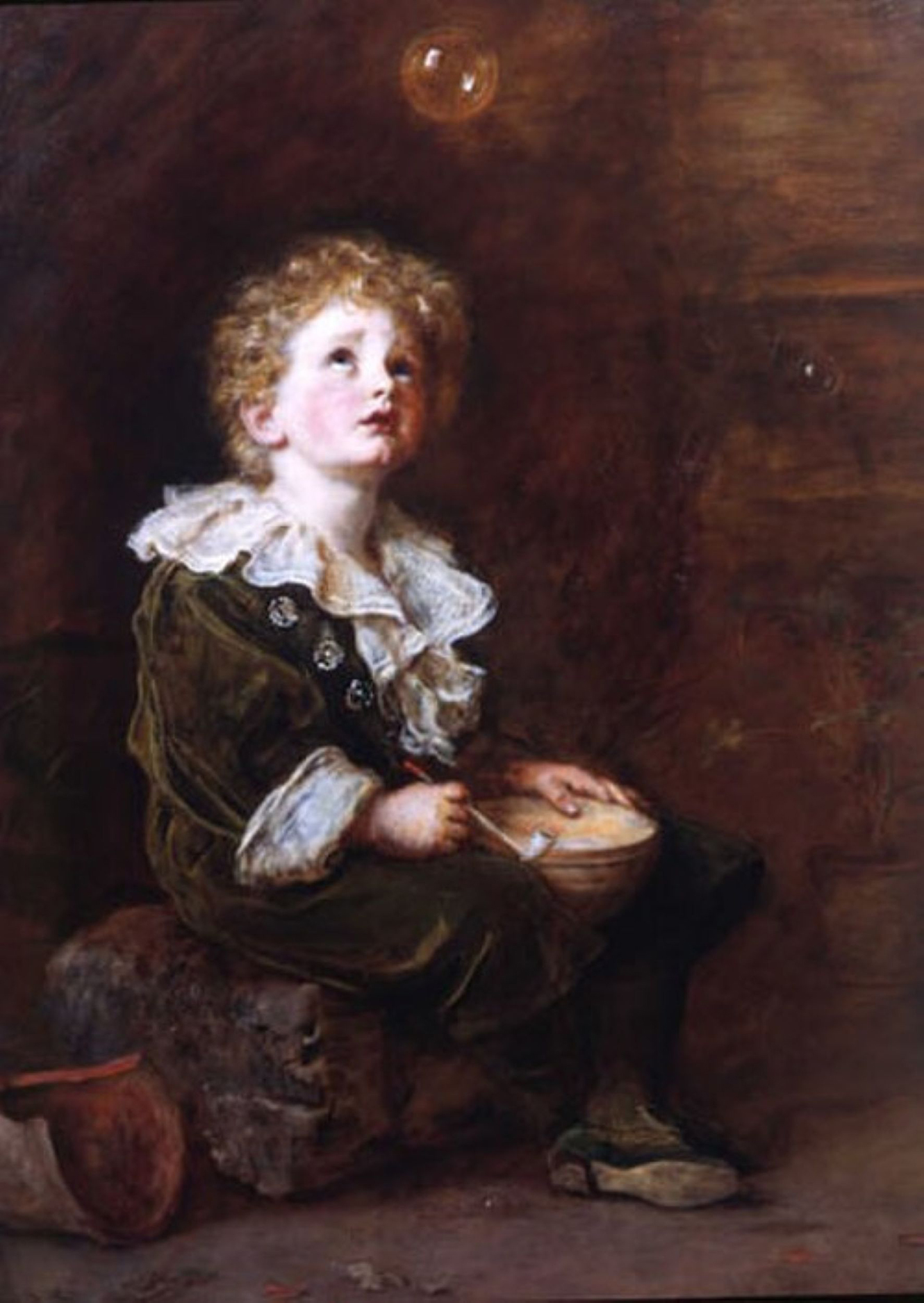
The beginnings of the power of art being hijacked into advertising came with Pearson soap using ‘Bubbles’, originally an oil painting titled A Child’s World, an 1886 painting by Sir John Everett Millais. Illustrated lettering had been a feature of religious publications painstakingly handwritten by monks on vellum, but the use of the press and newspapers allied to their conscription of emotive paintings changed the game. It went on changing of course, sometimes by plagiarism or simply by theft. The alliance of imagery and sales techniques began to mould visual perception around the messages of the commercial world.
Eventually the theft of art for commerce flipped, so commercial artists like Warhol and Ravillious became leaders in the art market although originally grown in the commercial world – Warhol as a window dresser, Ravillious as an illustrator for magazines and books. The boundary between art as a search for beauty and art as a profane tool for mind control had always been thin, with Renaissance paintings the voice of church and establishment; in the mid-twentieth century art vibrated between commercial or political mind control (think of the agitprop Soviet trains) and the desperate abstraction of those seeking art for art’s sake (Blast and the Vorticists).

The fight between sacred and profane was always one that the profane would win and art declined into decoration. The old art forms such as painting are now being eclipsed by the power of digital imagery. Artists who produce in the ‘meat world’ are encouraged to sell through digital media and the Gallery system collapses with an increasing number of big-name galleries merging or becoming the faces of digital enterprises. Artists follow the trend and begin focussing production on the digital. The competition for ‘eyeballs’ becomes globalised, an individual painting becomes lost in digital noise.
Worse, the result only exists electronically, and the recipient screen is not controlled either in size, definition or colour control. Nor can the time on screen be controlled by the creator. Art now becomes an instantaneous hit or nothing, as the art of contemplating a picture is replaced by the click of a browser button. Texture and the nature of the mark gain increasing irrelevance when the screen is the primary visual source.
For earlier generations an individual image can have huge impact, Tom Philips did an amazing painting of his teacher copying the Turner image of the ‘Fighting Temeraire’ in chalks on a blackboard. Now a teacher presents on an electronic screen, the scale and texture of the experience differing, the rarity now replace by profusion. Advertising images, aided by AI, are skilfully designed to reach the emotions, almost by-passing the critical brain. Contemplation is replaced by impact reinforced by repetition.
Wyeth’s painting reverberated with a generation familiar with the rural. The urban hive resonates with imagery that reflects a different reality. We see the urban decision makers abandoning the protections of rural communities. The nature of isolation changes – no longer about isolation as a product of a lone figure in an empty landscape, but isolation because one voice can no longer be heard amongst the myriads of calls manipulated by vested interests. More Lowry than Wyeth. Contemplation becomes conformity, individual thought a danger to the mass.
Cristina’s World affected how I see, my consciousness of myself as an individual brought up outside the hive. One of the images that has influence, in a way I wonder whether individual images created by individual hands will ever be able to stand and influence in the way images have done in the past. A composer friend once said to me I was lucky as an individual artist not to have my work swallowed in way musical compositions are swallowed by the commercial world. He did not see that the commercial appetite that corrupted his musical world has the same destructive influence of the visual, but that as with music so in the visual art, a new reality is born.
One in which my craft, that of the painter seeing anew, recording vision in paint, no longer has a place. There are many of Andrew Wyeths descriptive ‘flat tyres’ around now as the ‘art market’ changes.


Leave a Reply